
Business idea
A workspace for better growth experiments
Build a single proposal-to-decision workflow that preserves what a team expected and what it learned.
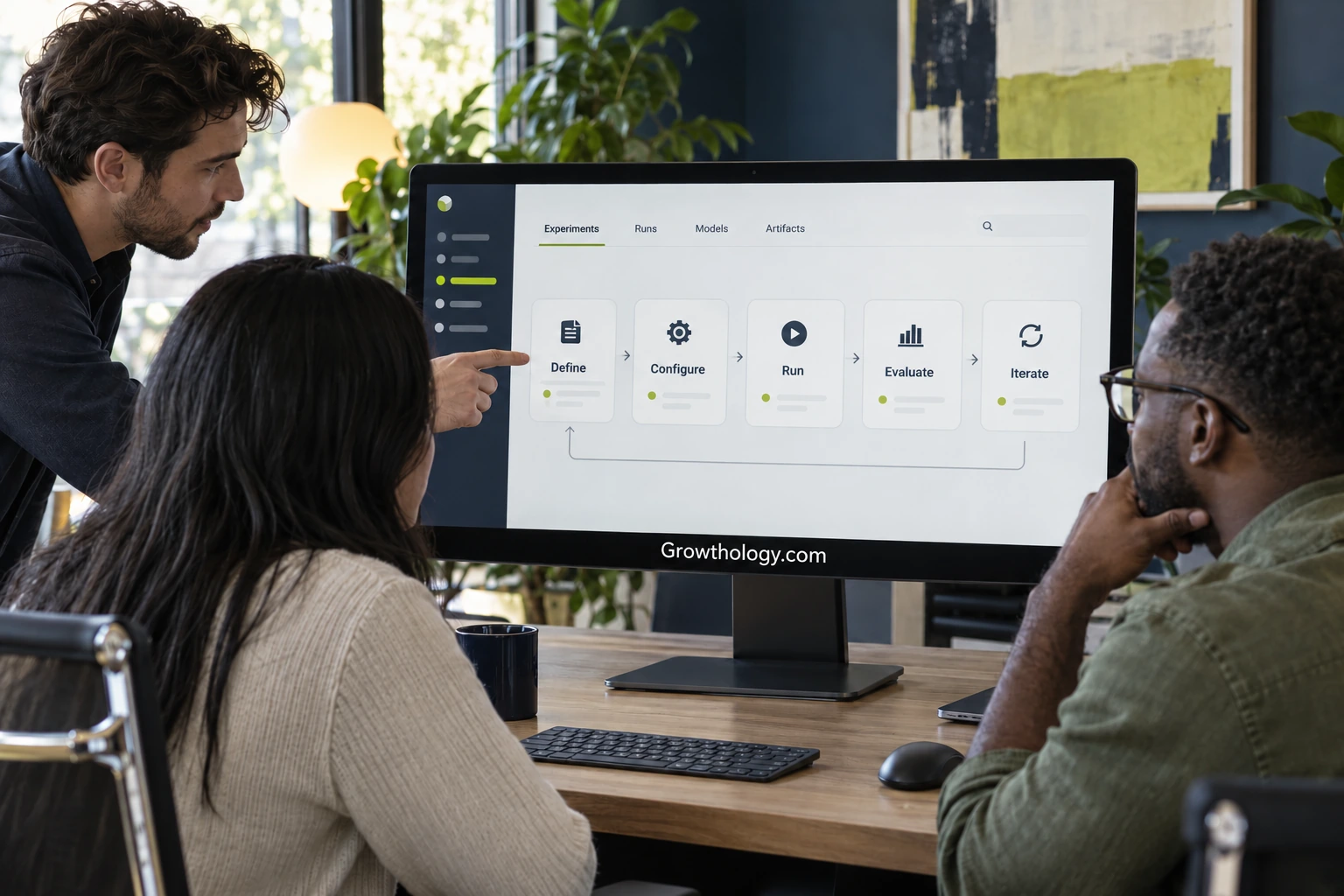
A team can have plenty of ideas and still lose track of what it has learned. Hypotheses sit in messages, a test owner changes the plan halfway through, and the result gets summarized in a meeting that nobody records. An experiment workspace could make the whole sequence easier to inspect.
Growthology.com could suit a software product built around that job. The following is an illustrative product concept for a future owner, not an existing application. The first customer would be a small product or growth team that already runs tests but struggles to keep the reasoning and follow-up together.
Choose the handoff before choosing features
The first workflow should start with a proposal and end with a decision. Someone identifies a problem, writes a hypothesis, gets a review, runs the work and records what happened. The workspace should show where the proposal is waiting and who can move it forward.
That is a narrower starting point than a general project manager. A project manager can track whether a task is complete. An experiment record needs to preserve what the team expected, how it planned to evaluate the change and what the evidence allowed it to conclude. Those fields let a reviewer compare the original expectation with the final decision.
Interview several teams about their last completed experiment. Ask to see the original plan and the final review. Where did the reviewer have to reconstruct missing context? Which document was considered the current version? Which decision never made it into the record? These answers are better inputs for a prototype than an abstract wish list of analytics features.
Make the record useful at three moments
At intake, the record should identify the customer problem, proposed change, primary observation and owner. The writer should distinguish an observation from an assumption. For example, several new users asked for help finding the import button. That is evidence of a usability problem worth investigating. It does not prove that moving the button will improve activation.
Before launch, the review should make the test boundaries visible. Which users are included? What remains unchanged? What would cause the owner to pause the test? What time or evidence limit ends the observation period? The product could require a reviewer to confirm that the plan is understandable before it can move to an active state.
After the work, the record should contain the result and decision separately. A result describes what was observed. A decision explains whether the team will adopt the change, revise it, gather more evidence or stop. Keeping those separate makes it harder for a disappointing result to disappear behind a cheerful summary.
A worked product example
Imagine a small subscription software team testing a revised import screen. The product owner proposes showing a sample file beside the upload control because support conversations suggest that people do not know which format to use. The engineer links the implementation task. The reviewer asks the team to define a successful import and explain how it will recognize unrelated failures.
The workspace stores that discussion beside the plan. When the team begins observation, the plan becomes a preserved version. New concerns can be added as notes, but changing the decision rule requires an explicit revision. At review, the owner can attach a small evidence summary and state whether the screen should ship, change or return to research.
The first version of the software might support that whole sequence with a form, a status list, comments and an export. It need not calculate statistical significance or claim to decide which experiments are valid. A clear history and a complete review packet are useful capabilities that can be demonstrated directly.
Give the buyer a manageable first offer
The initial offer could be a shared workspace for one team, with a limited pilot and a hands-on setup session. The buyer should know what information must be entered, who administers access and how records can be exported. A team evaluating new software will also want to understand what happens to its notes if it leaves.
Permissions deserve attention early. A workspace may contain customer observations or internal business context. The product should help teams decide what belongs in a record, limit access appropriately and avoid encouraging the upload of unnecessary personal information. These are product design responsibilities, not a claim that a prototype already satisfies every organization's requirements.
Find users through the workflow
A credible distribution path is a practical experiment review demonstration. Publish one anonymized or invented example that shows a proposal before and after review. Explain what changed in the plan and why the reviewer asked those questions. A team lead can compare that process with the current habit inside their own organization.
Invite a small group of prospective users to bring a plan into a guided session. Watch where they hesitate and what they refuse to enter twice. The founder can use those sessions to decide whether the product should connect to existing tools or stay deliberately simple. Selling a visible workflow gives the conversation more substance than advertising a promise of faster growth.
Keep the difficult work visible
Execution requires more than building the form. The owner needs dependable access controls, sensible record retention, useful search and a way to preserve revisions. Adoption also depends on the review meeting: if nobody asks for the record, people may stop updating it. The software should support the team habit rather than assume a new dashboard creates that habit.
A practical next step is to prototype one complete experiment from intake to final decision. Test it with a team that already has an example to reconstruct. If the workflow saves confusion and the team wants to repeat it, that is a reason to develop the product further. To discuss acquiring the identity for this direction, inquire about Growthology.com and describe the first team and workflow being considered.
Ready to make Growthology yours?
Start a conversation about the domain.